Why Curiosity Is The Innovation Skill Your Company Needs Now
Every leader fears their business going stale and staff turnover as team members leave for newer, shinier businesses in the same field.
As AI and rapid change reshape markets, the real advantage isn’t just tech, it’s human curiosity. Curious teams ask better questions, spot new opportunities, and turn disruption into fresh value. Here’s why curiosity matters for innovation, and how to start building it today.

Why curiosity drives innovation
Curiosity is not a soft extra, it’s a practical skill that fuels creativity, experimentation and breakthrough ideas. When teams are encouraged to ask “what if…?” and test wild hypotheses, they create more concepts to iterate on, refine and scale. That kind of creative throughput is precisely what modern innovation demands: more experiments, faster learning, and better product‑market fit.
Curiosity + human insight = smarter use of AI
AI excels at pattern recognition and speed; humans excel at framing the right problems and interpreting meaning. Curious people probe assumptions, ask new questions about AI outputs, and combine machine speed with human judgement to design solutions that are useful, ethical, and surprising. In short, curiosity helps you get more value from AI, not less.
A global “imagination deficit” and the cost of inaction
Deloitte’s 2024 Human Capital Trends found a striking gap: 73% of leaders say keeping human capabilities in step with technology is important — but only 9% say they are making real progress. Deloitte warns of an “imagination deficit” if organisations fail to cultivate creativity and curiosity. The chart below illustrates that many know curiosity matters, but far fewer are taking meaningful action.
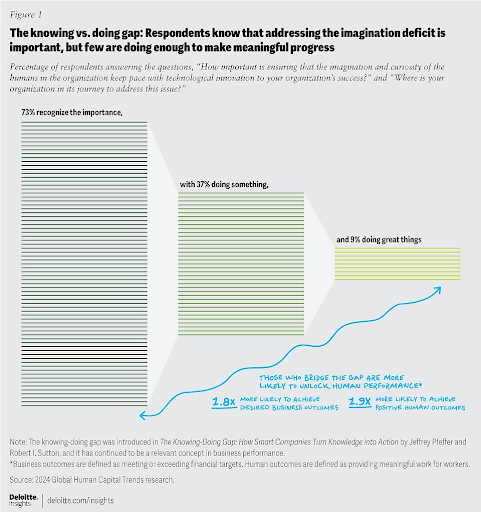
(source: 2024 Global Human Capital Trends research in Deloitte)
This chart, illustrating research from Deloitte, shows that while 73% of leaders say imagination and curiosity are important, only 9% report making progress: illustrating. This is the “knowing vs. doing” gap
What curious teams actually do differently
They test more ideas. Small, frequent experiments increase the odds of hitting a breakthrough.
They challenge assumptions. Asking “why?” and “what if?” reveals hidden opportunities others miss.
They work cross‑functionally. Curiosity encourages reaching outside silos to combine knowledge in new ways.
They recover faster from setbacks. Curiosity reframes failure as data, not defeat.
Why training helps
Curiosity can be taught and encouraged. Structured practices and facilitation help teams form habits that turn sporadic inspiration into repeatable results. Our Online Curiosity Training embeds short daily prompts, weekly team tasks and monthly quests designed to build these habits across your organisation, so curiosity becomes measurable in its impact.
Want your team to stop reacting to change and start shaping it? Contact Curious Agenda to find out how our Curiosity Training helps organisations turn curiosity into innovation and resilience.
Keep checking back for quick tips on how you can build curiosity into your daily routine.